
Date: 23 Oct 2026 - 23 Oct 2026
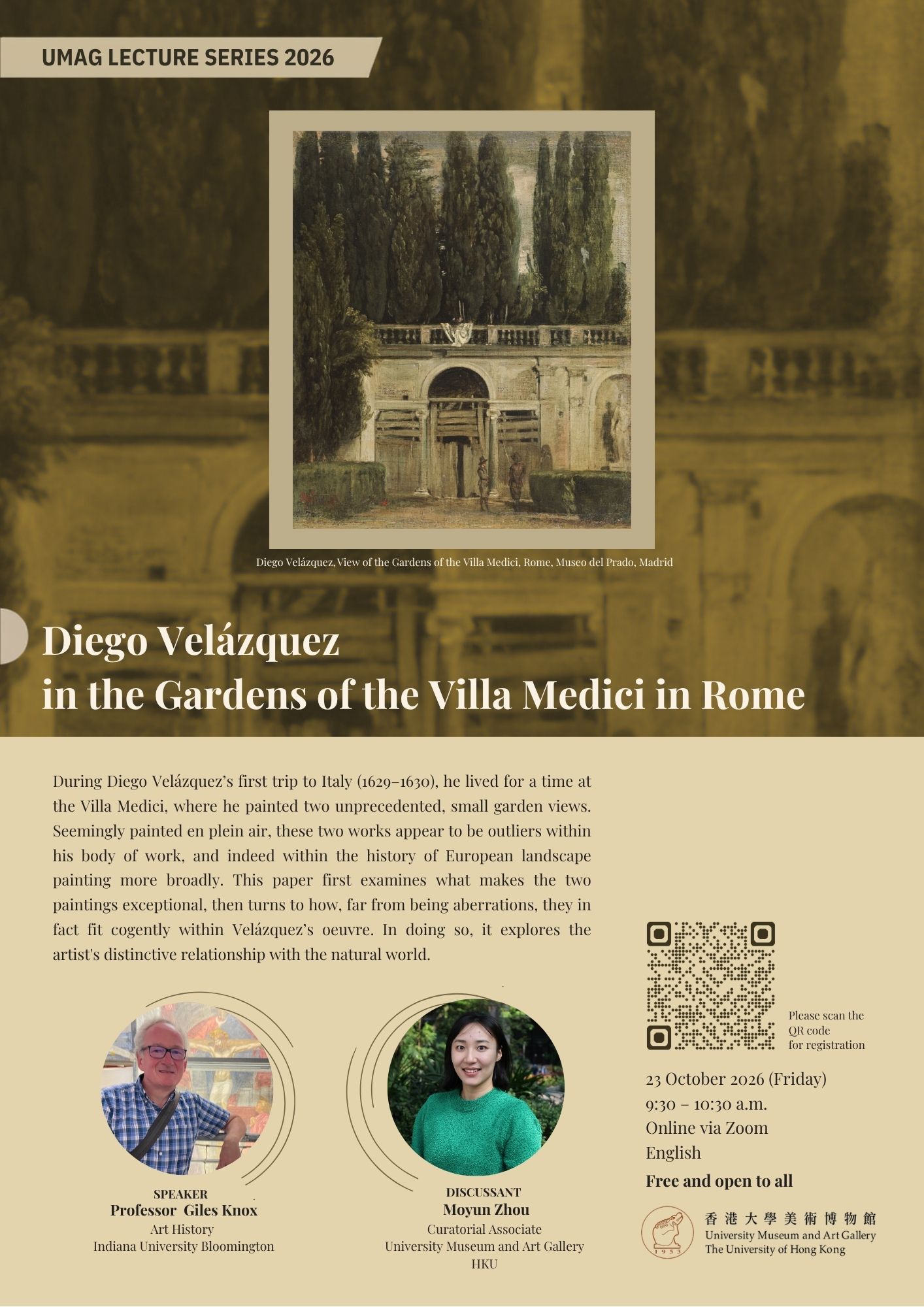
During Diego Velázquez’s first trip to Italy (1629–1630), he lived for a time at the Villa Medici, where he painted two unprecedented, small garden views. Seemingly painted en plein air, these two works appear to be outliers within his body of work, and indeed within the history of European landscape painting more broadly. This paper first examines what makes the two paintings exceptional, then turns to how, far from being aberrations, they in fact fit cogently within Velázquez’s oeuvre. In doing so, it explores the artist’s distinctive relationship with the natural world.
This is a part of the UMAG Lecture Series 2026. For other lectures in the series, please click here.
Speaker: Professor Giles Knox, Art History, Indiana University Bloomington
Discussant: Dr. Moyun Zhou, Curatorial Associate, University Museum and Art Gallery, HKU
Speaker
Professor Knox’s research has long focused on Velázquez. His first book, translated into Spanish as Las últimas obras de Velázquez: Reflexiones sobre el Estilo pictórico, was published in 2010. In 2017, he co-edited, with Tanya Tiffany, Velázquez, Re-Examined: Theory, History, Poetry, and Theatre. In 2019, Professor Knox published Sense Knowledge and the Challenge of Italian Renaissance Art: El Greco, Velázquez, Rembrandt, and in 2022, Masterpiece in Residence: Velázquez’s King Philip IV of Spain from the Frick Collection.