
Date: 10 Feb 2026 - 10 Feb 2026
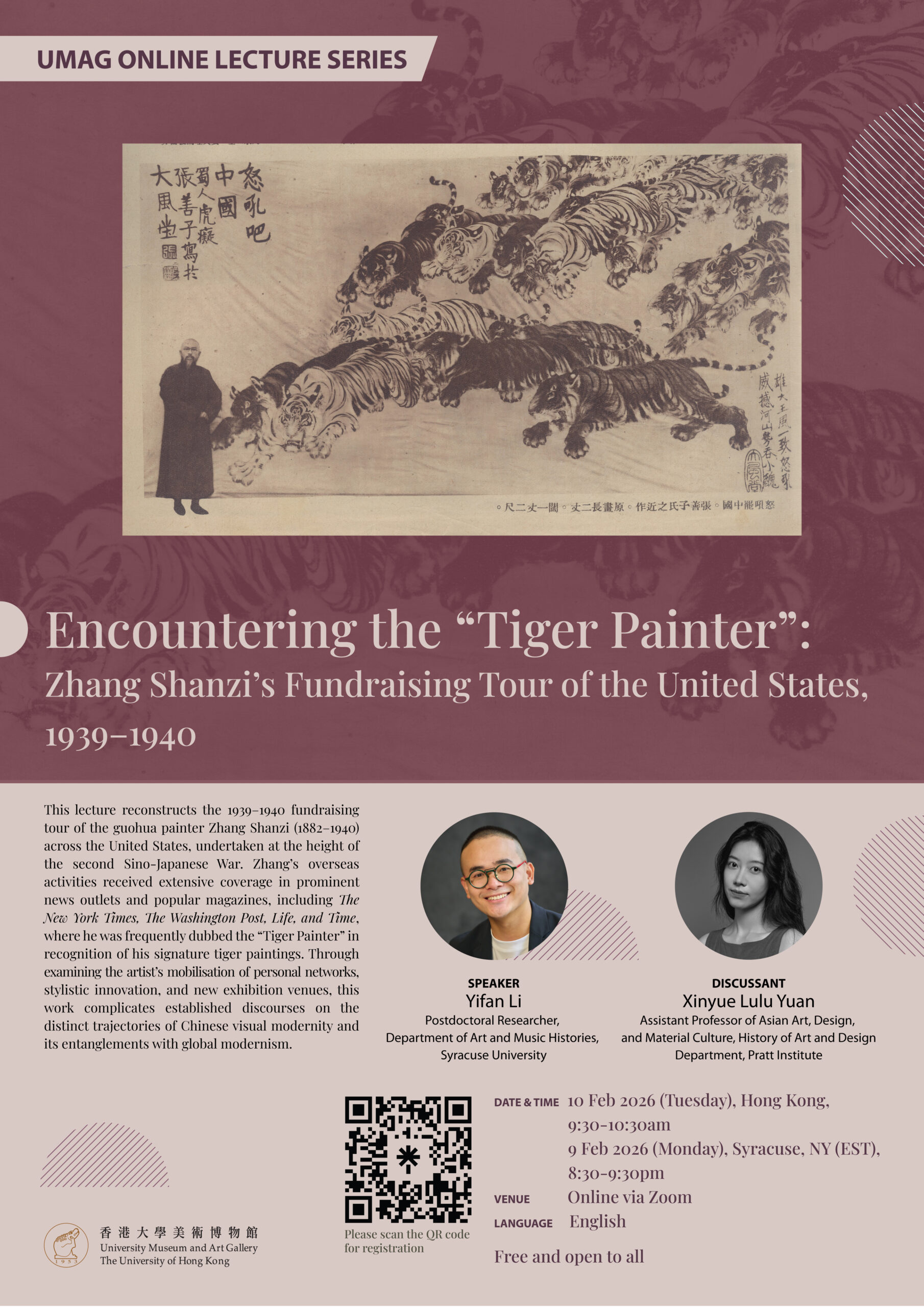
This lecture excavates the little-known history of the artistic exchange between China and the United States at the height of the second Sino-Japanese War (1937–1945) by examining the 1939–1940 fundraising tour of the guohua painter Zhang Shanzi (1882–1940) across the United States. Zhang’s overseas activities received extensive coverage in prominent news outlets and popular magazines, including The New York Times, The Washington Post, Life, and Time, where he was frequently dubbed the “Tiger Painter” or “Tiger Man” in recognition of his signature tiger paintings. By analysing the pictorial and textual documentation of the painter’s encounters with his American audiences and supporters, this study provides a textured account of the diverse implications of Chinese animal painting, the public roles of artists as cultural diplomats and philanthropists, and the contributions of modern Chinese art to what historian Gordon H. Chang has termed the “fateful ties” between the two nations during World War II. As the speaker argues, Zhang’s transpacific relocation generated a critical framework for reconsidering the multifaceted significance of modern Chinese art during wartime displacement—as political statement, humanitarian mission, instrument of cultural diplomacy, and vehicle for diasporic identity-making. Through reconstructing how the border-crossing “Tiger Painter” mobilised personal networks, stylistic innovation, and new techniques and spaces for image-making and dissemination, this work further complicates established discourses on the distinct trajectories of Chinese visual modernity and its entanglements with global modernism.
This is a part of the UMAG Online Lecture Series. For other lectures in the series, please click here.
Speaker: Yifan Li, Postdoctoral Researcher, Department of Art and Music Histories, Syracuse University
Discussant: Xinyue Lulu Yuan, Assistant Professor of Asian Art, Design, and Material Culture, History of Art and Design Department, Pratt Institute
Speaker
Yifan Li is a Postdoctoral Researcher in the Department of Art and Music Histories at Syracuse University, United States. A specialist in modern Chinese art and visual culture, his work explores how art-making shaped the identity formation among Chinese artists as they engaged in transnational exchanges and transmedial practices within the broader context of global modernism. Li’’s current book project examines the visual representation of the politics and aesthetics of infrastructure campaigns in the early People’s Republic of China. He has also contributed to curatorial projects in collaboration with North American museums, including the exhibition China’s Southern Paradise: Treasures from the Lower Yangzi Delta at the Cleveland Museum of Art. He earned his PhD from The Ohio State University in the United States in 2024, following academic training in mainland China, Taiwan, Hong Kong, and Canada.