
日期: 2026年6月11日 - 2026年6月11日
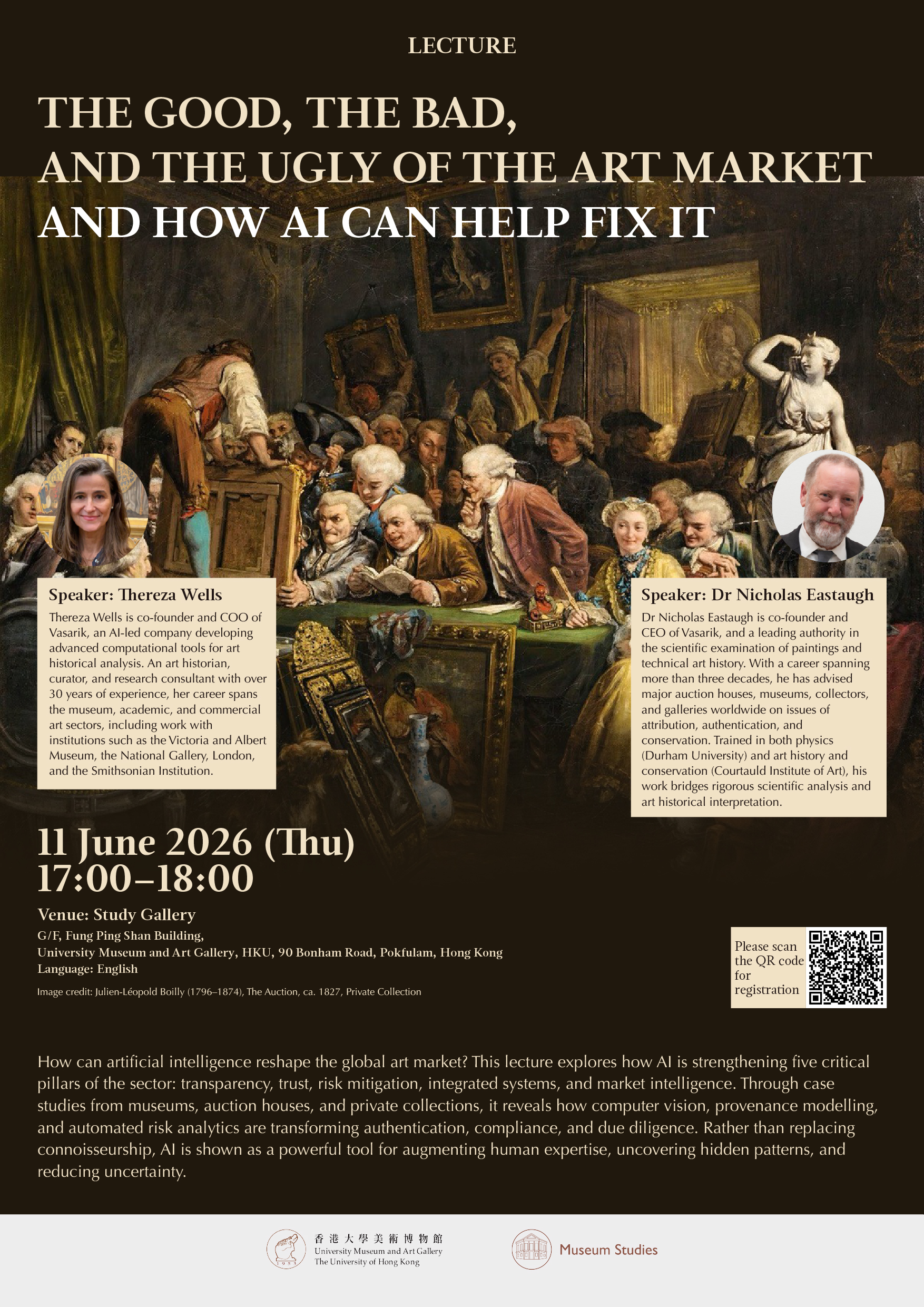
This lecture examines how artificial intelligence can help transform the global art market’s core infrastructure. It argues that future resilience and growth depend on five essential pillars: Transparency, Trust, Risk Mitigation, Integrated Systems, and Insightful Intelligence, and shows how AI can materially strengthen each category.
The art market’s persistent structural weaknesses include opaque transactions, fragmented expertise systems, uncertain or incomplete ownership history (provenance), escalating compliance requirements, and slow, manual due diligence. Using concrete examples such as computer vision tools that can assess artworks, machine learning models that flag provenance gaps, automated risk mitigation, and integrated collection management platforms, the lecture demonstrates how emerging technologies are already reshaping practice.
Case studies from museums, auction houses, and private collections illustrate how AI–supported provenance modelling, risk analytics, and data harmonisation can improve authentication, enhance regulatory compliance, and generate more reliable market intelligence.
Rather than replacing connoisseurship, the lecture argues that AI can augment human expertise by providing structured evidence, finding hidden patterns, and reducing avoidable risk. The result is a more transparent, trusted, and analytically rigorous art market ecosystem, one capable of meeting the demands of a rapidly evolving global landscape.
Date: Thursday, 11 June, 2026
Time: 5:00–6:00 p.m.
Venue: Study Gallery, G/F, Fung Ping Shan Building, UMAG, HKU, 90 Bonham Road, Pokfulam, Hong Kong
Language: English
Please click here to register.
Speaker
Dr Nicholas Eastaugh is co-founder and CEO of Vasarik, and a leading authority in the scientific examination of paintings and technical art history. With a career spanning more than three decades, he has advised major auction houses, museums, collectors, and galleries worldwide on issues of attribution, authentication, and conservation. Trained in both physics (Durham University) and art history and conservation (Courtauld Institute of Art), his work bridges rigorous scientific analysis and art historical interpretation.
In 2009, he founded Art Analysis & Research Ltd, establishing a pioneering laboratory integrating material science and art historical research to museum standards. A co-founder of the Pigmentum Project, he has led influential research on historical pigments, including the widely cited Pigment Compendium.
Dr Eastaugh’s recent work focuses on applying AI, data mining, and Bayesian statistical methods to model artists’ material practices over time. He is widely recognised for his role in uncovering the Wolfgang Beltracchi forgery scandal, and continues to shape new, data-driven approaches to authenticity, provenance, and art historical analysis.
Thereza Wells is co-founder and COO of Vasarik, an AI-led company developing advanced computational tools for art historical analysis. An art historian, curator, and research consultant with over 30 years of experience, her career spans the museum, academic, and commercial art sectors, including work with institutions such as the Victoria and Albert Museum, the National Gallery, London, and the Smithsonian Institution.
Wells’ scholarship sits at the intersection of technical art history, material analysis, and digital innovation. She specialises in Italian Renaissance and Early Modern painting, with expertise in Leonardo da Vinci and his contemporaries, alongside broader work on British and European art. Her research has contributed to major exhibitions and publications, including studies on Leonardo’s notebooks and paintings, as well as Wellcome Trust–funded collaborations between contemporary artists and scientists.
At Vasarik, her work focuses on enhancing transparency, accountability, and scalability in art historical research and the art market, bridging rigorous academic methodologies with emerging technologies to enable new forms of analysis and due diligence across auction houses, collections, and institutions.