
日期: 2026年2月25日 - 2026年2月25日
“I became weary of avant-garde art,” declared Japanese art critic Hariu Ichirō in 1962. His remark, published in Geijutsu Shinchō, perceptively captured the proliferation—and growing ambiguity—of artworks labeled “avant-garde” in postwar Japan. Throughout the 1950s and 1960s, the term came to signify radical formal experimentation and a contested ideological terrain. Hariu’s fatigue anticipated what later theorists, beginning with Peter Bürger’s Theory of the Avant-Garde (1974), would diagnose as the avant-garde’s historical exhaustion.
The 1960s marked a transitional decade in Japanese art, culminating in Expo ’70 in Osaka as a symbolic apex of the postwar era. In the years that followed, artists and critics grappled with the residual ideologies of earlier avant-garde movements and their apparent dissolution. The early 1970s still bore traces of collectives such as the Gutai Art Association, Neo Dada Organizers, Hi Red Center, and Mono-ha—groups that had emerged amid the social and political turbulence of the previous generation. By the 1970s, however, responses to the avant-garde diverged: some artists continued to pursue its radical possibilities, while others rejected the label as historically obsolete. Meanwhile, critics, art historians, and institutions began to historicize avant-garde practices, transforming them into objects of reflection and exhibition rather than instruments of rupture, and sealing it within the transparent enclosure of “(art) history.”
How, then, did the avant-garde “die”? What became of an art world that had lost faith in its transformative potential? And where did its legacies reemerge? Although the “death” of the avant-garde was a global discourse, this study examines its specific manifestations in 1970s Japan—a moment when the avant-garde’s afterlives took new forms in conceptual, environmental, and institutional practices. By tracing these reconfigurations, this talk reconsiders not the end of the avant-garde, but its mutations and reappearances within the shifting conditions of post-Expo Japan.
This is a part of the UMAG Online Lecture Series. For other lectures in the series, please click here.
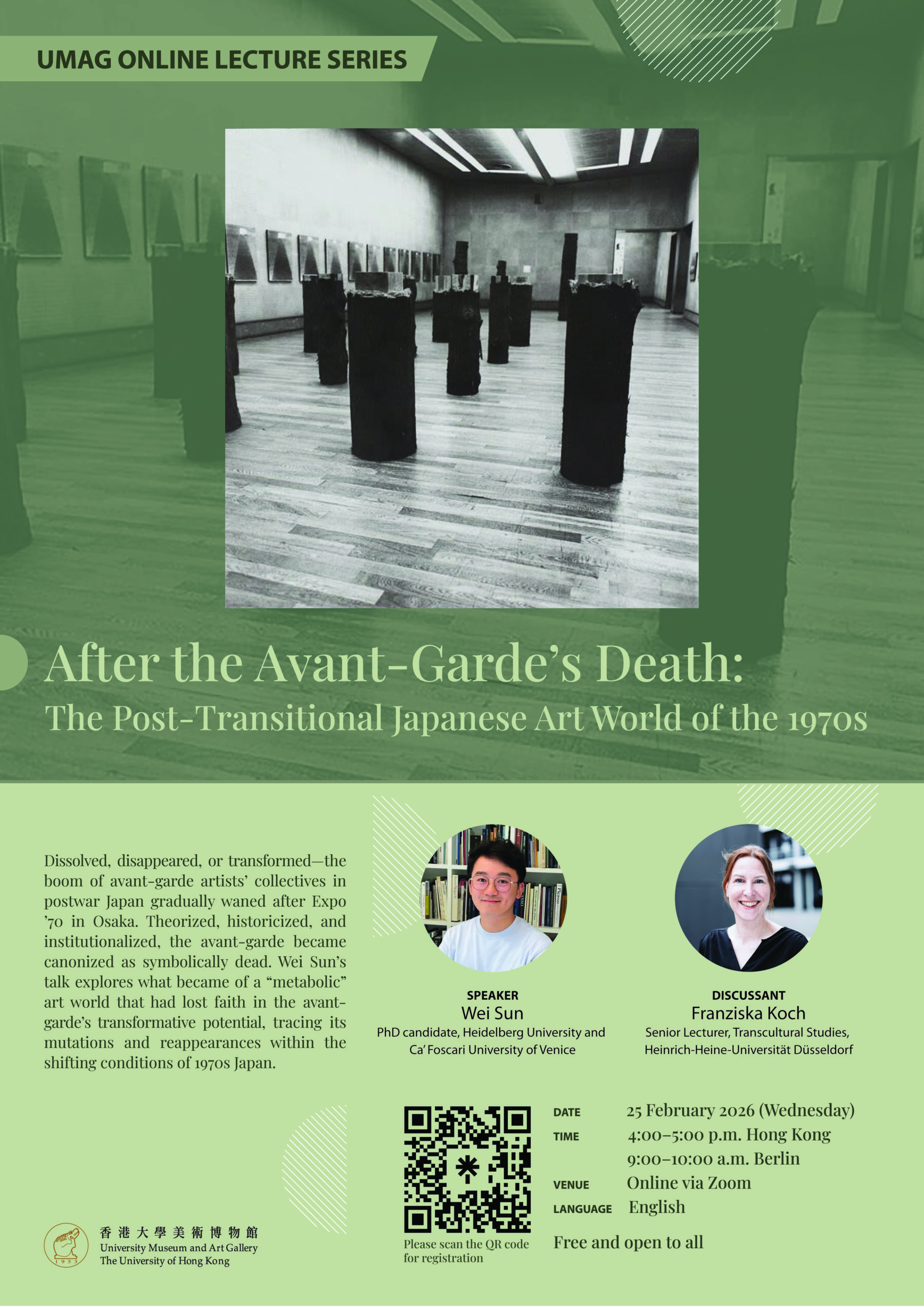
Speaker: Wei Sun, PhD candidate, Heidelberg University and Ca’ Foscari University of Venice
Discussant: Franziska Koch, Senior Lecturer, Transcultural Studies, Heinrich-Heine-Universität Düsseldorf
Speaker
Wei Sun is an art historian and translator of art writing. Currently pursuing a joint PhD at Heidelberg University and Ca’ Foscari University of Venice, his research focuses on exhibition history, notably the 1986 Japon des Avant-gardes exhibition, and the discursive development of Japanese avant-garde art in Euro-American museums. With experience living across East Asia and Europe, he explores transnational art dynamics, avant-garde theory, postwar Japanese art, exhibition studies, and art historiography. His research is supported by the Studienstiftung des deutschen Volkes. Wei Sun is a member of the project Ishibashi Foundation Digital Futures Scholars: Archives of Postwar Japanese Art in Europe and the author of Taro Okamoto: La métamorphose comme avant-garde (Paris 2025).