
Date: 18 Jun 2026 - 18 Jun 2026
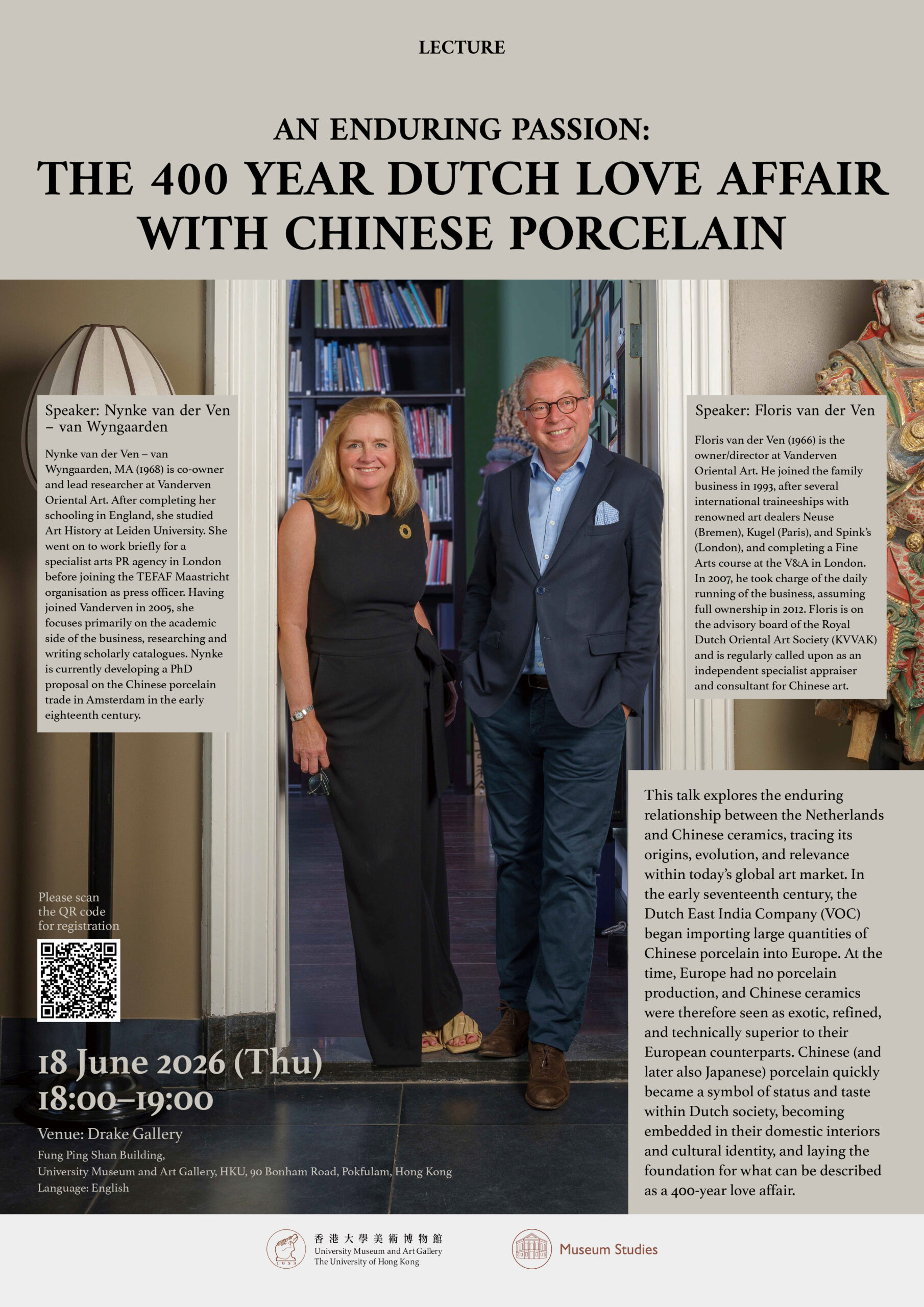
This talk explores the enduring relationship between the Netherlands and Chinese ceramics, tracing its origins, evolution, and relevance within today’s global art market. In the early seventeenth century, the Dutch East India Company (VOC) began importing large quantities of Chinese porcelain into Europe. At the time, Europe had no porcelain production, and Chinese ceramics were therefore seen as exotic, refined, and technically superior to their European counterparts. Chinese (and later also Japanese) porcelain quickly became a symbol of status and taste within Dutch society, becoming embedded in their domestic interiors and cultural identity, and laying the foundation for what can be described as a 400-year love affair.
We will consider why this passion has endured, exploring the layers of history, the long-standing cross-cultural exchange, and why these objects continue to resonate with collectors, scholars, and institutions. Using the trajectory of Vanderven Oriental Art as a case study, we reflect on how a business that began as a general antiques dealership evolved over nearly 60 years into the Netherlands’ leading international specialist in Chinese ceramics. This evolution mirrors a broader shift in the market toward deeper expertise, connoisseurship, and academic rigour.
However, the art market itself has also undergone a profound transformation over the past 25 years. The increasing dominance of international auction houses, the rise of digital platforms, and the ease of global travel have reshaped how objects are bought, sold, and understood. Access to information has expanded, but so too has competition and market volatility.
This raises a central question: is there still a place for highly specialised, scholarly dealerships in this fast-moving, increasingly transparent market? We argue that there is—not despite these changes, but because of them. In a landscape where objects circulate rapidly and authenticity is constantly scrutinised, the role of the specialist remains critical. Expertise, careful looking, and long-term relationships continue to provide a level of trust and depth that cannot be replicated by speed or scale alone.
We invite students to consider how history, commerce, and scholarship intersect—and how the enduring Dutch passion for Chinese porcelain offers a lens through which to understand the evolving dynamics of the global art market.
Date: Thursday, 18 June, 2026
Time: 6:00–7:00 p.m.
Venue: Drake Gallery, Fung Ping Shan Building, UMAG, HKU, 90 Bonham Road, Pokfulam, Hong Kong
Language: English
Please click here to register.
Speaker
Vanderven Oriental Art was established on the auspicious day 8-8-1968 by Clemens and Neeltje van der Ven, initially as a general antique dealership. A formative journey to Hong Kong and Taiwan in 1979 proved transformative, kindling a deep passion for Chinese art that led the gallery to specialise exclusively in Chinese ceramics and works of art.
The following year, Vanderven debuted at a Hong Kong art fair, marking the beginning of an enduring international presence. During this period, Clemens also co-founded two of the art world’s most prestigious events—TEFAF Maastricht and PAN Amsterdam—helping to shape the modern antiques market. Over the decades, Vanderven has gone on to participate in leading international fairs in Hong Kong, New York, and London.
Floris van der Ven (1966) is the owner/director at Vanderven Oriental Art. He joined the family business in 1993, after several international traineeships with renowned art dealers Neuse (Bremen), Kugel (Paris), and Spink’s (London), and completing a Fine Arts course at the V&A in London. In 2007, he took charge of the daily running of the business, assuming full ownership in 2012. Floris is on the advisory board of the Royal Dutch Oriental Art Society (KVVAK) and is regularly called upon as an independent specialist appraiser and consultant for Chinese art.
Nynke van der Ven – van Wyngaarden, MA (1968) is co-owner and lead researcher at Vanderven Oriental Art. After completing her schooling in England, she studied Art History at Leiden University. She went on to work briefly for a specialist arts PR agency in London before joining the TEFAF Maastricht organisation as press officer. Having joined Vanderven in 2005, she focuses primarily on the academic side of the business, researching and writing scholarly catalogues. Nynke is currently developing a PhD proposal on the Chinese porcelain trade in Amsterdam in the early eighteenth century.